
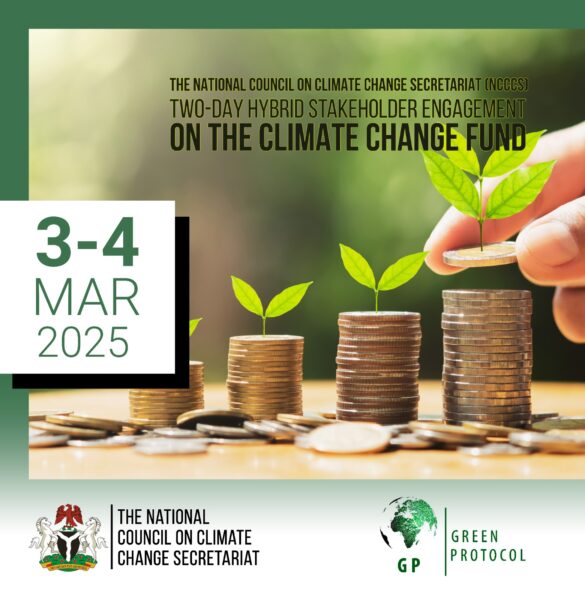
The National Council on Climate Change Secretariat (NCCCS), supported by Green Protocol, organized a 2-day hybrid stakeholder engagement on the Nigeria Climate Change Fund to address Nigeria´s financial needs and resources for climate change mitigation and adaptation. The event took place in Abuja on the 3rd and 4th of March, 2025. Stakeholders from diverse sectors were in attendance onsite and online, including: The legislators, government agencies, the private sector, diplomatic community, academia, civil society, and non-governmental organizations (NGOs). The meeting had two clear objectives:
- To develop a Climate Change Fund Framework for Nigeria.
- To craft a Climate Change Taxonomy for Nigeria.
The Director General of the National Council on Climate Change Secretariat (NCCCS), Dr. Nkiruka Maduekwe, in her welcome remark emphasized the need for Nigeria to have a Climate Change Fund mechanism on ground to boost investment and drive climate action. The Nigeria Project Coordinator for Green Protocol Nigeria, Deborah Anumenechi, also highlighted that financing remains at the heart of effective climate action, therefore, the establishment of the Climate Change Fund for Nigeria is a crucial step toward mobilizing sustainable and predictable financing for Nigeria´s climate ambitions.
Stakeholders from diverse sectors shared their input on what Nigeria´s Climate Change Fund should be like. They stated that Nigeria´s Climate Change Fund should have a robust but simple and effective structure, a solid corporate governance structure, and be commercially focused, because investors want a return on their investment. The community must be engaged; therefore, the Corporate Social Responsibility (CSR) component should be incorporated in the framework. Stakeholders also discussed what constitutes climate finance, sources of climate finance in Nigeria, and the criteria for selecting climate change projects. Additionally, stakeholders discussed on how to balance funds between climate change adaptation and mitigation, ensuring a transparent and accountable structure, promoting capacity building, and exploring opportunities for blended finance.
On the second day of the event, stakeholders discussed extensively and gave suggestions on crafting a robust Climate Change Taxonomy for Nigeria to drive greater access to funding for critical climate action initiatives and also help Nigeria meet its Nationally Determined Contributions (NDCs) targets. They suggested that a sectoral approach should be applied when developing a Climate Change Taxonomy for Nigeria. This should be done in phases, by identifying sectors and then introducing thresholds, reviewing them, and adjusting them subsequently. The Climate Change Taxonomy should reflect the goals of our Nationally Determined Contributions (NDCs), and at the same time, align with international standards.
At the end of the 2-day stakeholder engagement, we were able to come up with a draft Climate Change Fund Framework, providing a solid footing for climate finance in Nigeria, though still subject to criticism and adjustment. The event concluded with a closing remark from the Director General of the National Council on Climate Change Secretariat (NCCCS), who appreciated everyone for their presence, time, and invaluable contributions.